AI receptionist vs a human receptionist for a service business
By the Margin Media team · Updated
For a service business, a human receptionist is better at everything that happens in the room and at calls that need judgement, and an AI receptionist is better at the calls a person cannot reach: lunch, after five, weekends and the second line. The honest answer for many offices is both, with the AI covering the gaps.
What can each one do that the other cannot?
A human receptionist can greet the person at the counter, calm an upset customer, notice that something is wrong and bend a rule when it makes sense. In a dental office or a salon, that person is part of why customers come back. No AI does that.
An AI receptionist can answer two calls at once, at nine at night, on a Sunday, without a lunch break or a sick day. It does not put a caller on hold while it checks someone in. It cannot leave the phone, and it cannot read a room.
How do they compare side by side?
The table shows where each one is strong. Notice that the rows do not overlap much, which is why choosing one over the other is often the wrong question for a busy front desk.
| Human receptionist | AI receptionist | |
|---|---|---|
| Hours | The hours they are paid to work | Day, night and weekends |
| Two calls at once | One waits or goes to voicemail | Both are answered |
| People in the room | Greets them, checks them in | Cannot help |
| Judgement calls | Strong | Passes them to your team |
| Time off | Lunch, holidays, sick days | None |
When is a human receptionist the better choice?
A human receptionist is the better choice when the bottleneck is in the building, not on the phone: check-ins, paperwork, a waiting room, customers who expect a familiar face. It is also the better choice when nearly every call is complicated or emotional, as in a home care agency or a small law firm doing sensitive intake.
How does Margin fit beside your front desk?
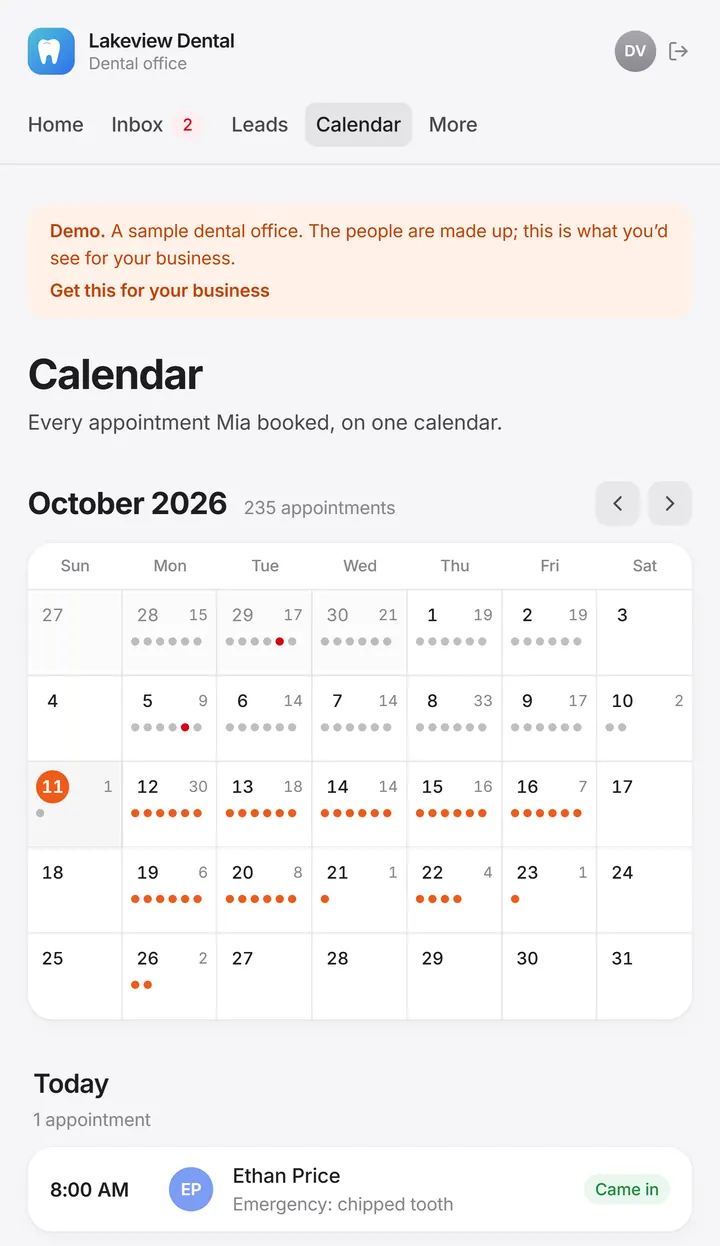
Margin sets Mia up so your front desk stays. She can pick up only the calls your team misses: at lunch, after hours and when the lines are busy. She answers questions, takes messages and books an open time. When a caller asks for a person, she tells the office and steps aside. Bookings land on the portal calendar and your office is told.
What Margin sets up for this.
- Mia, the AI receptionist, on every call
- Booking onto your calendar
- Your portal: every call, text and booking
What a business needs is decided on its audit. It is a one-time setup fee and a monthly fee, with exact numbers on the audit.
Related questions
Will an AI receptionist replace my front desk?
It does not have to. In a service business an AI receptionist can be set to answer only the calls the front desk cannot get to, which leaves your staff free for the people standing in front of them.
Can an AI receptionist handle an angry caller?
It can stay polite, take the details and pass the call to a person. It should not try to settle a complaint. In a service business, an upset customer is a job for a human, and a good setup hands them over quickly.
How do I know if my service business needs either one?
Call your own business at lunch, just after closing and on Saturday morning. If it rings out or goes to voicemail, a service business has a gap on the phone. Then decide whether a person or an AI should cover it.