How should a home care agency handle a hospital discharge call at night?
By the Margin Media team · Updated
A home care agency should handle a night-time discharge call by answering it live, taking the facts calmly, and getting the family to the person on call who can say whether and when care can start. The call-taker's job is to listen, record and hand over, never to make care decisions or promises about staffing.
What does the family need from that call?
They need to know they have reached someone, that the details are written down, and what will happen next and when. They do not need a sales pitch. A caller in this position is tired and often upset, so the tone matters as much as the answer: slow, plain and kind.
What are the steps to set this up?
Write the process down before the next call arrives, so it doesn't depend on who happens to be holding the phone that night. Six steps cover it.
- Decide who is on call each night for new enquiries, and share the rota with everyone who answers.
- Write a short list of facts to take: caller's name, number, relationship, town, and when help is wanted.
- Agree what counts as urgent and must reach the on-call person the same evening.
- Tell call-takers in writing what they must never do: advise on care or promise a start date.
- Give the on-call person a set time within which to ring the family back.
- Review each night-time enquiry the next morning to check the family was reached.
What should the call-taker not do?
Whoever answers, person or machine, should not give care or medical advice, guess at what the family needs, or commit the agency to hours it may not be able to staff. If the caller describes an emergency, they should be told to ring the emergency services. Everything else is a hand-over to the coordinator who can decide.
How does Margin handle an urgent night call for a home care agency?
Mia, Margin's AI receptionist, answers at night the same as in the day. She takes the family's details, answers questions about the agency, and never pretends to be a person. Anything urgent is passed straight to the agency's team. On the audit, Margin goes through who is on call and how a family should reach them, before anything is built.
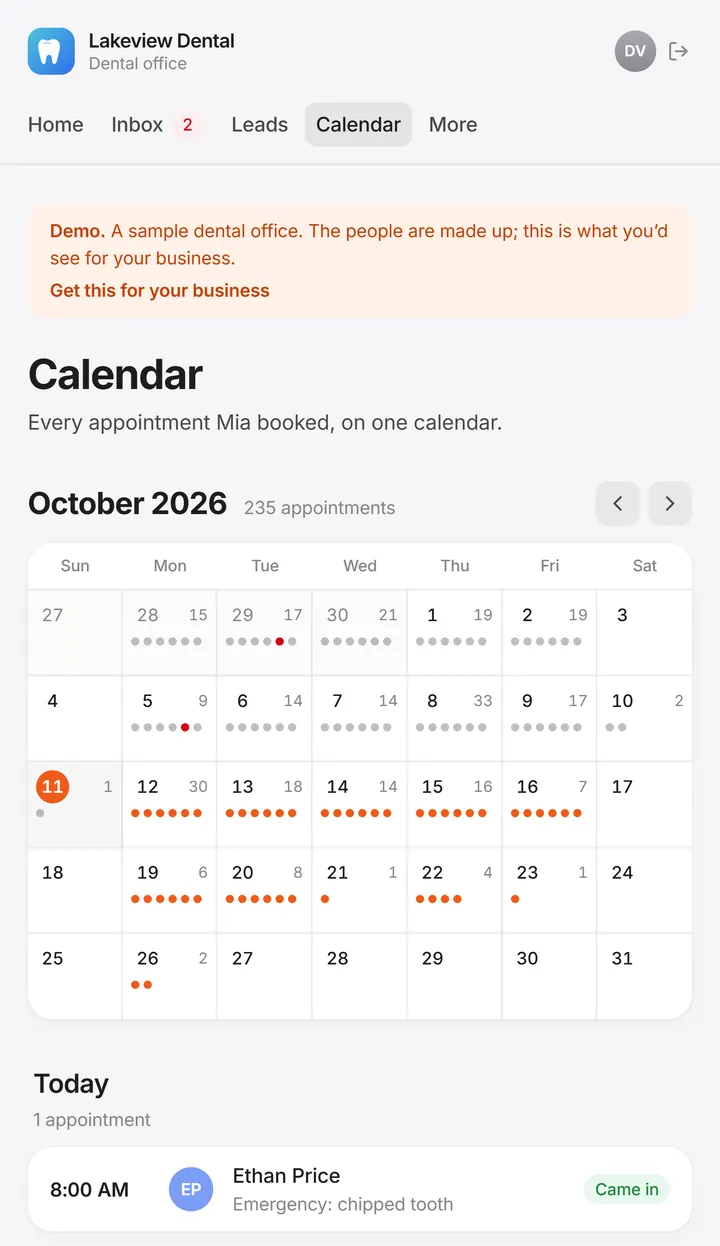
She does not give care advice or make staffing promises. When a caller asks for a person, she tells the office and steps aside. Where an assessment can be booked, it lands on the portal calendar and the office is told.
What Margin sets up for this.
- Mia, the AI receptionist, on every call
- Booking onto your calendar
- Your portal: every call, text and booking
What a business needs is decided on its audit. It is a one-time setup fee and a monthly fee, with exact numbers on the audit.
How Margin works for home care agenciesSee the portal with a sample business
Related questions
Can an AI receptionist take an upset family's call for a home care agency?
It can take the call, listen and pass it on, and whether the manner is good enough is something to judge by ringing one yourself. A home care agency should make sure urgent calls reach a person and that the AI says what it is when asked.
Who should be on call for new enquiries at a home care agency?
Someone who can decide. A home care agency's on-call person for new families should know current caregiver availability and be able to say honestly whether an assessment and a start are possible, and when.
What information should a home care agency take on a first call?
Take only what is needed to call back and arrange an assessment: the caller's name and number, their relationship to the person needing help, the town, and how soon help is wanted. A home care agency should leave detailed health questions for the assessment.