Why does my home care website get visitors but no calls?
By the Margin Media team · Updated
A home care website gets visitors but no calls when it talks about the agency instead of answering the family's question, hides the phone number, or offers only a long form. Families arrive worried and short of time. They call the agency whose site tells them, in plain words, what happens next and who will pick up.
Who is actually visiting a home care website?
Often an adult son or daughter, on a phone, in the evening, after a hard day with a parent. They want to know three things: do you cover my parent's town, can you help with this situation, and what happens when I call. Some visitors are caregivers looking for work, which makes the visitor count look better than it is.
What stops a family from calling?
Open your site on a phone, as a family would late in the evening, and try to call your office with one thumb. Then look for these six things.
- The phone number is not at the top of every page, or cannot be tapped.
- The only way to enquire is a form with many fields.
- No page says which towns you serve.
- Nothing explains what the first call or the assessment involves.
- Stock photos and no names, so there is nobody to trust.
- The careers link is louder than the enquiry button.
What should the site say instead?
It should say what a family can expect, in order: you call, someone answers, we ask about your parent's day, we arrange an assessment at home, and care can begin after that. Keep to what your agency does. Leave out anything that reads as medical advice, and say plainly when a call will be answered.
How does Margin build a home care website?
Margin builds or rebuilds the site around one outcome: a family picking up the phone. That means a number at the top of every page, short pages that each answer one question, a clear page for each town served, and a separate route for caregiver applicants so they don't crowd the enquiry line.
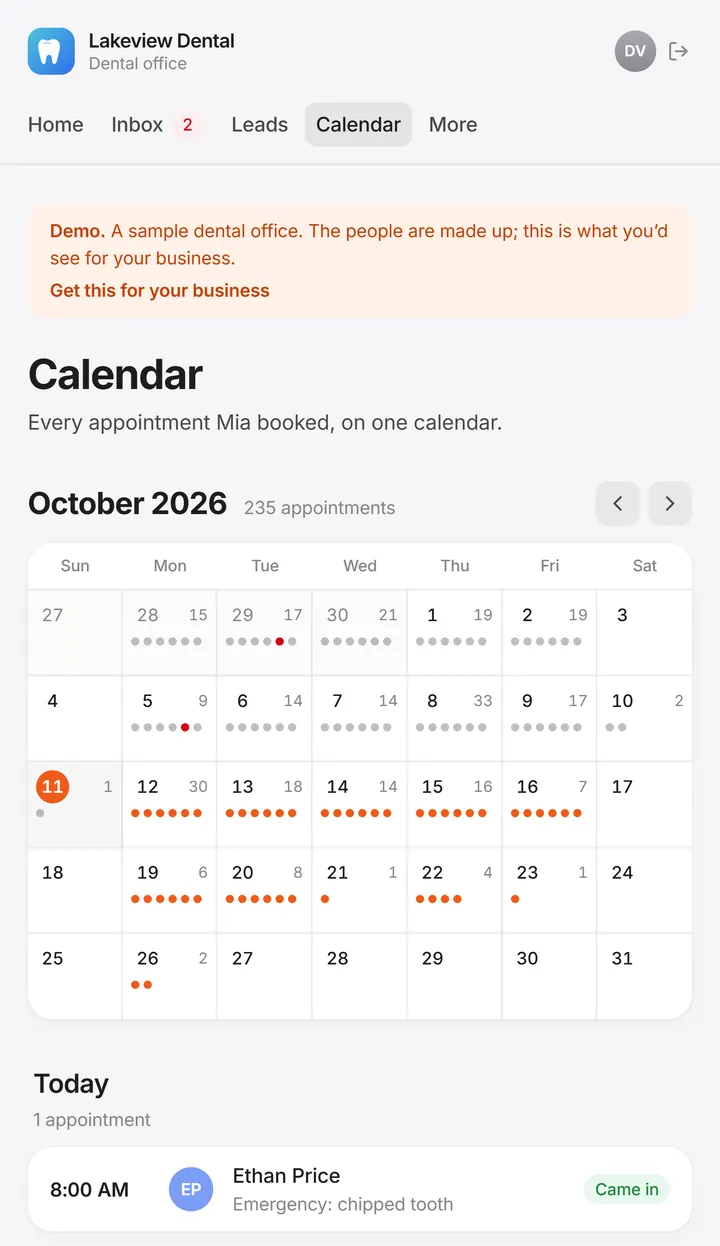
A site that produces calls needs the calls answered. Mia, the AI receptionist, can pick up at any hour and book the assessment onto the portal calendar, with the office told. Whether an agency needs a new site or only changes is settled on the audit.
What Margin sets up for this.
- A website built to turn a visitor into a call
- Mia, the AI receptionist, on every call
- Booking onto your calendar
- Google profile and local ranking
What a business needs is decided on its audit. It is a one-time setup fee and a monthly fee, with exact numbers on the audit.
How Margin works for home care agenciesSee the portal with a sample business
Related questions
Should a home care website have online booking?
It can help, as long as there is still a phone number. A family arranging home care tends to have questions before choosing a time, so a home care website should offer both: a number that is answered and a simple way to ask for a call back.
How do I know if my home care website is working?
Count enquiries, not visitors. A home care website is working when you can trace calls, forms and booked assessments back to it each month. Visitor totals include job seekers and existing families, so they say little by themselves.
Should caregiver job applications be on the same home care website?
Yes, but on their own page with their own form, and ideally their own phone number. Mixing the two on a home care website sends applicants to the enquiry line and makes it harder for a family to find what they came for.