How do I stop caregiver job calls tying up my home care office line?
By the Margin Media team · Updated
A home care agency stops caregiver job calls tying up its office line by giving hiring its own route: a separate number on every job advert, an online application that answers the common questions, and set times for recruiter call-backs. The main number is then kept for families and current clients, and nobody waits behind an applicant.
Why do applicants end up on the family line?
Because it is the only number they can find. Job adverts, the website header and the Google profile all show the main line, so someone asking about pay, shifts or the status of their application rings it. In a hiring push those calls can outnumber client enquiries, and each one holds a line or a person.
What are the steps to separate the calls?
The aim is not to put applicants off. You need them. It is to give them a faster route that doesn't run through the phone a family is trying to reach.
- Set up a second phone number for hiring and route it to your recruiter or a hiring voicemail.
- Put that hiring number, never the main line, on every job advert and careers page.
- Publish an application page that states shifts, areas, requirements and what happens after applying.
- Send each applicant an automatic message confirming receipt and saying when they will hear back.
- Block out two set times a day for recruiter call-backs, and tell applicants those times.
- Count calls on the main line for one week by type: family, applicant, current client, other.
What about current clients and caregivers on shift?
They need the main line, or a line of their own, and they need it answered. A caregiver calling off a shift or a client asking where their caregiver is cannot wait behind anyone. Whatever you set up, make sure these calls have a clear path to the scheduler or the person on call.
How does Margin handle mixed calls for a home care agency?
Mia, Margin's AI receptionist, answers every call at once, so a family is never held in a queue behind applicants. She never puts anyone on hold. What she does with each kind of caller is gone through on the audit: families, caregivers looking for work, and the people the agency already looks after.
The agency is told plainly what she would handle. Anything else goes to the team as a short list of people to call back, with the whole conversation attached, and urgent matters are passed straight to the team. Every call and its transcript sits in the portal.
What Margin sets up for this.
- Mia, the AI receptionist, on every call
- Booking onto your calendar
- Your portal: every call, text and booking
What a business needs is decided on its audit. It is a one-time setup fee and a monthly fee, with exact numbers on the audit.
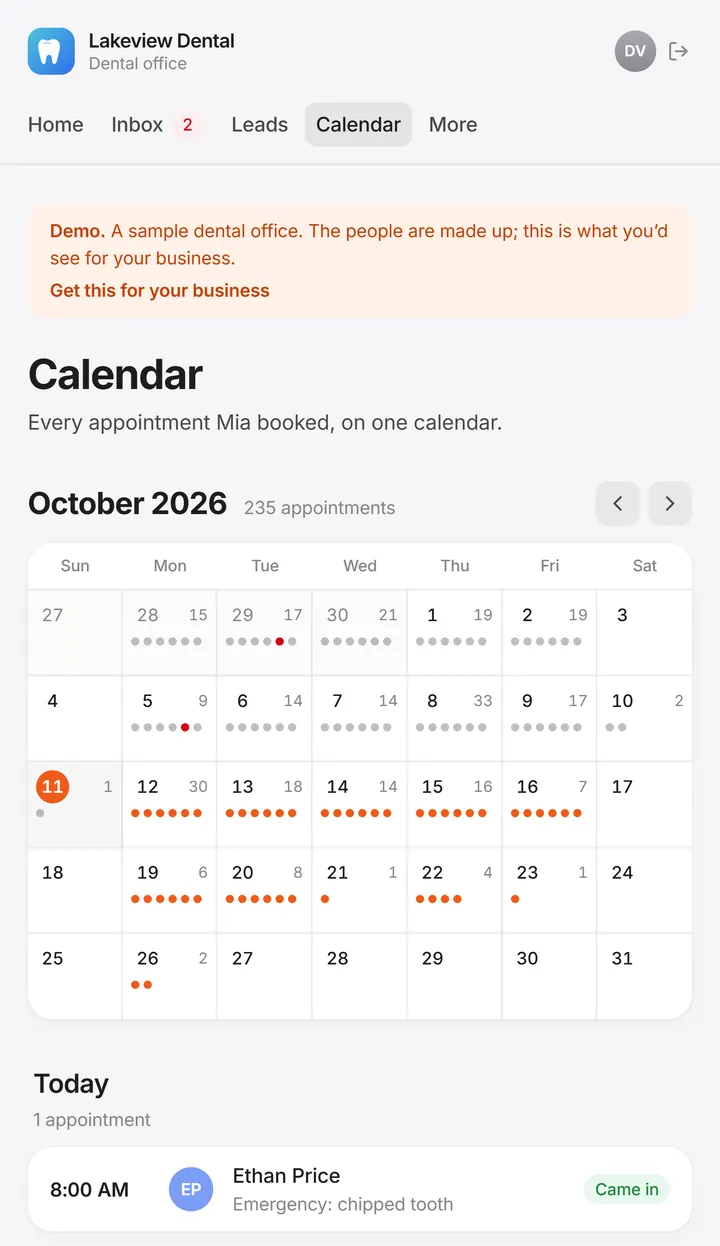
How Margin works for home care agenciesSee the portal with a sample business
Related questions
Should a home care agency have a separate phone number for hiring?
Yes, if applicant calls are reaching the same people who handle family enquiries. A separate hiring number lets a home care agency keep its main line clear, and it shows how many calls recruiting really generates each week.
How do I know how many of my home care calls are job seekers?
Tally them. For one week, have whoever answers the home care office phone mark each call as family, applicant, current client or other. A week of tick marks is enough to show whether applicants are crowding out enquiries.
Can an AI receptionist answer caregiver applicants for a home care agency?
What an AI receptionist does with applicant calls should be decided before it is set up. A home care agency should list the questions applicants ask and choose which get an answer, which get a link to the application, and which go to the recruiter.