Phone tree vs a live answer for a cosmetic surgery practice
By the Margin Media team · Updated
For a cosmetic surgery practice, a phone tree suits existing patients who know what they need, and a live answer suits new patients who do not. A menu sorts calls without answering anyone. A first-time caller asking about a procedure wants a voice, and a list of options to press gives them a reason to hang up.
What does each one do well?
A phone tree is good at routing. If your calls are a mix of post-operative patients, suppliers and billing questions, a menu gets each to the right desk without a receptionist. A live answer, whether a person or an AI receptionist, is good at conversation: it can find out what the caller wants and deal with it there.
| Phone tree | Live answer | |
|---|---|---|
| What the caller hears first | A recorded list of options | A greeting and a question |
| New patient enquiries | Routed to a line that may not pick up | Answered and offered a consultation time |
| Existing patients | Quick, if they know which option they need | Quick, but uses someone's time |
| After hours | Tends to end in voicemail | Depends on who or what is answering |
| Cost to run | Little once set up | A wage, a service fee or a monthly fee |
| Booking a consultation | Cannot do it | Can do it during the call |
When is a phone tree the better choice?
A phone tree is the better choice when nearly all your callers are existing patients with routine needs, and when every option on the menu leads to a person who answers. It also costs less to run. If that describes your practice, keep it, and make sure the new-patient option is first and leads somewhere staffed.
Where do phone trees lose new patients?
They lose them at the menu and at the end of it. A nervous first-time caller listens to five options, none of which is quite theirs, and guesses. The guess rings a desk where the coordinator is in a consultation. Now they have waited through a menu to reach a voicemail.
How does Margin answer the phone for a cosmetic surgery practice?
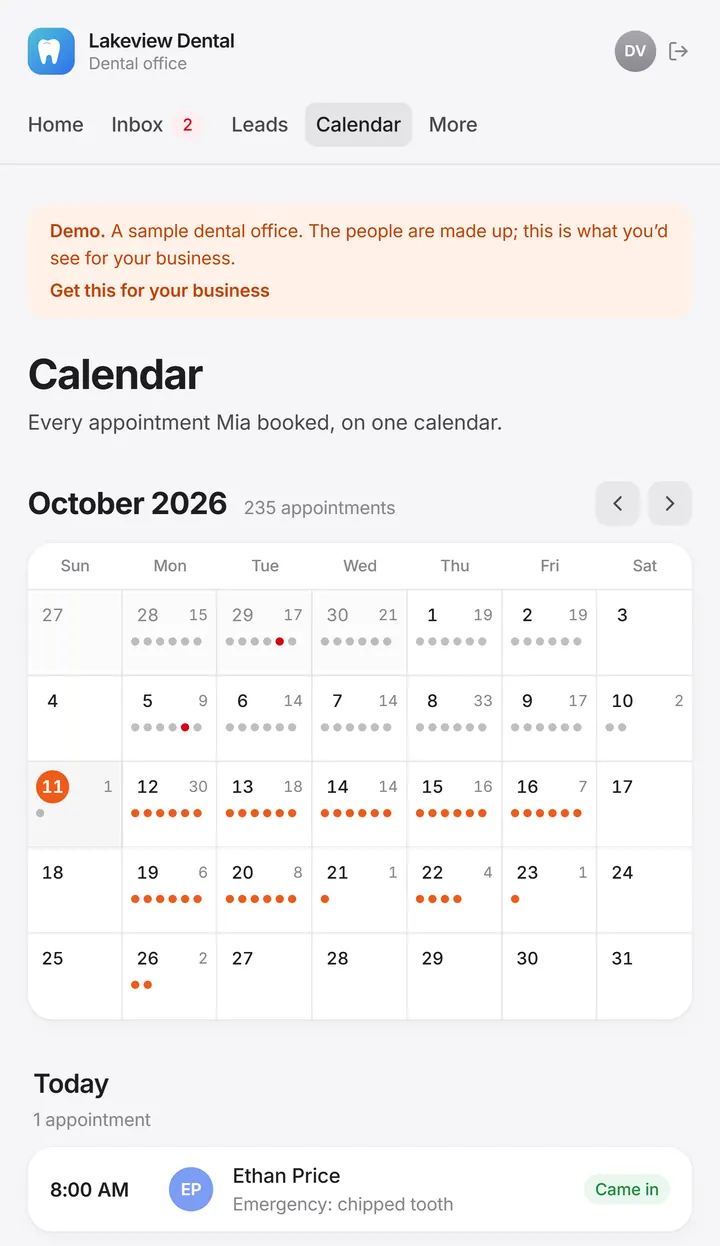
Mia, Margin's AI receptionist, answers with a greeting in your practice's name, with no menu and no hold. She answers questions, takes messages and books consultations onto the portal calendar, and the office is told. When someone asks for a person, she tells the team and steps aside.
She can take every call, or only the ones nobody picks up, so a practice can keep its existing set-up for known patients. Calls can go live within days of the kickoff call. Call her on (689) 345-9108 to judge for yourself.
What Margin sets up for this.
- Mia, the AI receptionist, on every call
- Booking onto your calendar
What a business needs is decided on its audit. It is a one-time setup fee and a monthly fee, with exact numbers on the audit.
How Margin works for cosmetic and elective medical practicesSee the portal with a sample businessThe Surgery Accelerator, for plastic surgeons
Related questions
Do patients hang up on phone trees at cosmetic surgery practices?
Some do, and your call log will show it as short calls that never reached a person. For a cosmetic surgery practice the callers most likely to give up are new ones, who are unsure which option applies to them.
Can a cosmetic surgery practice use a phone tree and an AI receptionist together?
In principle, yes. A cosmetic surgery practice can keep a short menu for existing patients and send new enquiries, overflow and after-hours calls to an AI receptionist. How calls are routed depends on your phone set-up.
How many options should a cosmetic surgery practice's phone menu have?
As few as possible, with new patients first. A cosmetic surgery practice that needs more than a handful of options is asking callers to do the sorting, and a short menu that reaches a real answer beats a long one.