How should an HVAC company handle after-hours emergency calls?
By the Margin Media team · Updated
An HVAC company should handle after-hours emergency calls by answering every one live, sorting urgent from routine with a few set questions, sending urgent calls to a named on-call person, and booking the rest for the morning. The failure to avoid is a recording, because a homeowner with no heat at night calls the next company.
What goes wrong with after-hours calls today?
What goes wrong is that the night line is either voicemail or the owner's mobile. Voicemail loses the job. The owner's mobile loses the owner's sleep, and it rings just as loudly for a thermostat question as for a house with no heat. Neither sorts the calls, so the real emergencies are buried among the ones that could wait.
What are the steps to set up after-hours cover?
Write this down once and give it to whoever, or whatever, answers at night. The same page works for a tech, a service or an AI receptionist.
- Define an emergency in writing: no heat in freezing weather, no cooling in dangerous heat, and whatever else you choose.
- Tell anyone reporting a gas smell or a carbon monoxide alarm to leave the house and call the emergency services first.
- Write three or four questions that sort every other caller into urgent or routine.
- Name the on-call person for each night, with a second name if the first does not answer.
- Decide what a routine caller is offered, such as the first opening tomorrow morning.
- Decide what callers are told about after-hours rates before a tech is sent.
- Test it by calling your own line at night once a month.
Who should answer the night line?
There are three realistic options. An on-call tech who answers directly knows the trade but is woken by every call. An answering service puts a person on the line and pages your tech, working from a short script. An AI receptionist answers at once, asks your sorting questions and books the routine calls, but urgent ones still need a human on your side to wake up.
How does Margin handle HVAC calls at night?
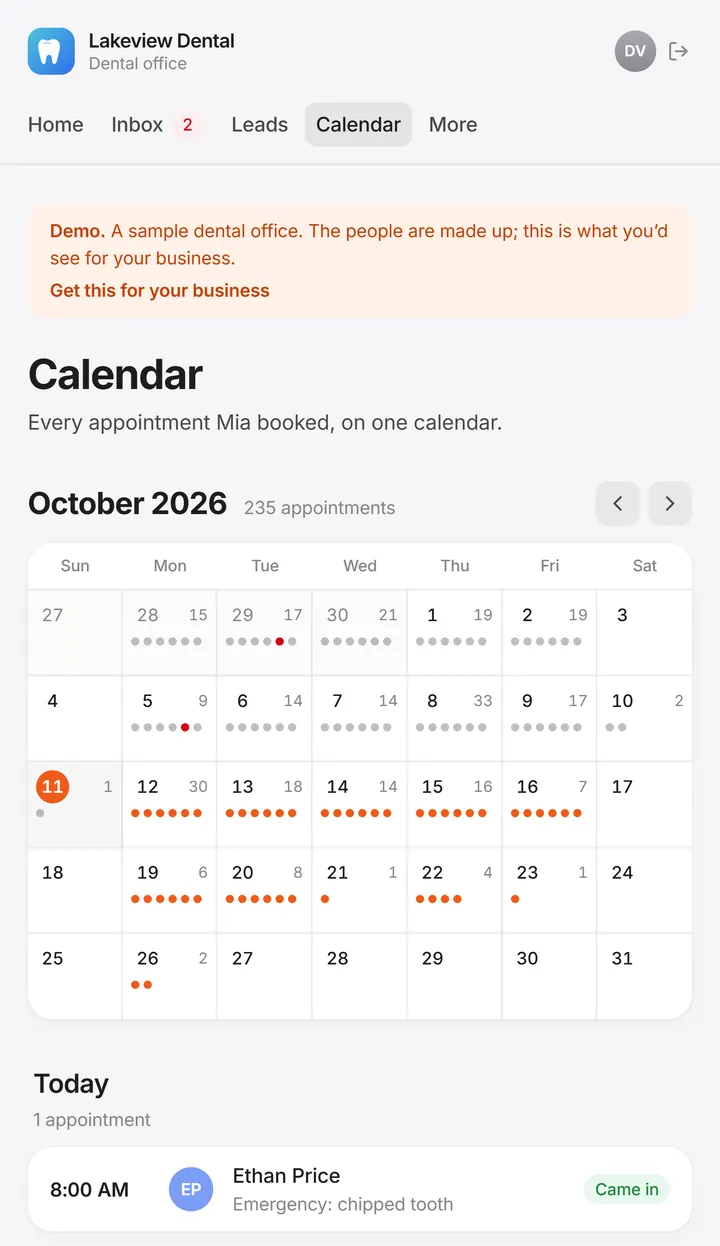
Mia answers at two in the morning the same as at two in the afternoon. Routine calls are booked onto your portal calendar and the office is told. Anything urgent is passed straight to your team.
Who is on call and how an emergency should reach them is gone through on your audit, before anything is built. What callers are told about price is settled there too. Every night call, with the whole conversation, is in your portal the next morning.
What Margin sets up for this.
- Mia, the AI receptionist, on every call
- Booking onto your calendar
- Your portal: every call, text and booking
What a business needs is decided on its audit. It is a one-time setup fee and a monthly fee, with exact numbers on the audit.
How Margin works for HVAC companiesSee the portal with a sample business
Related questions
Does an HVAC company have to offer 24-hour service?
No. An HVAC company can choose not to send techs at night. But the phone should still be answered, so an urgent caller learns what you can do and a routine one is booked for the morning instead of calling someone else.
What counts as an HVAC emergency?
Each HVAC company sets its own line. Examples are no heat in freezing weather, no cooling in dangerous heat, or a vulnerable person in the home. A gas smell or a carbon monoxide alarm is for the emergency services and the gas utility first.
Can an AI receptionist wake my on-call HVAC tech?
An AI receptionist can pass an urgent call to your team the moment it is identified. How that reaches the on-call HVAC tech, and who is next if they do not answer, should be agreed and tested before it goes live.