AI receptionist vs answering service for a cosmetic surgery practice
By the Margin Media team · Updated
For a cosmetic surgery practice, an answering service puts a real person on the line who takes a message, while an AI receptionist answers instantly, handles several calls at once and can book the consultation. Choose the service if a human voice matters most to you. Choose the AI if the booking and the follow-up matter more.
How do the two compare?
They compare differently depending on what you need the call to achieve. An answering service is people in a call centre working from a script for many businesses. An AI receptionist is software that speaks in your practice's name. Neither replaces your coordinator for a detailed conversation.
| Answering service | AI receptionist | |
|---|---|---|
| Who answers | A person at a call centre | An AI, which should say so when asked |
| Busy times | Callers may wait or be put on hold | Answers every call at once |
| Booking a consultation | Depends on the service; sometimes a message only | Can book during the call |
| Follow-up with those who did not book | Rarely part of the service | Can follow up by text |
| Unusual or emotional calls | A person can use judgement | Hands off to your team |
| How it is charged | Ask: by the minute, by the call or flat | Ask: flat fee or by usage |
When is an answering service the better choice?
An answering service is the better choice when your callers are often distressed or elderly, when you want a human being on every call as a matter of principle, or when all you need is a reliable message after hours. A good one is polite and steady. If your team calls every message back quickly, the patient is well served.
When is an AI receptionist the better choice?
An AI receptionist is the better choice when the aim is a booked consultation, not a message. It suits a practice whose enquiries come in bursts after an ad goes out, at night, or while the coordinator is with a patient. It is also the option that carries on by text with the callers who did not book.
How does Margin compare for a cosmetic surgery practice?
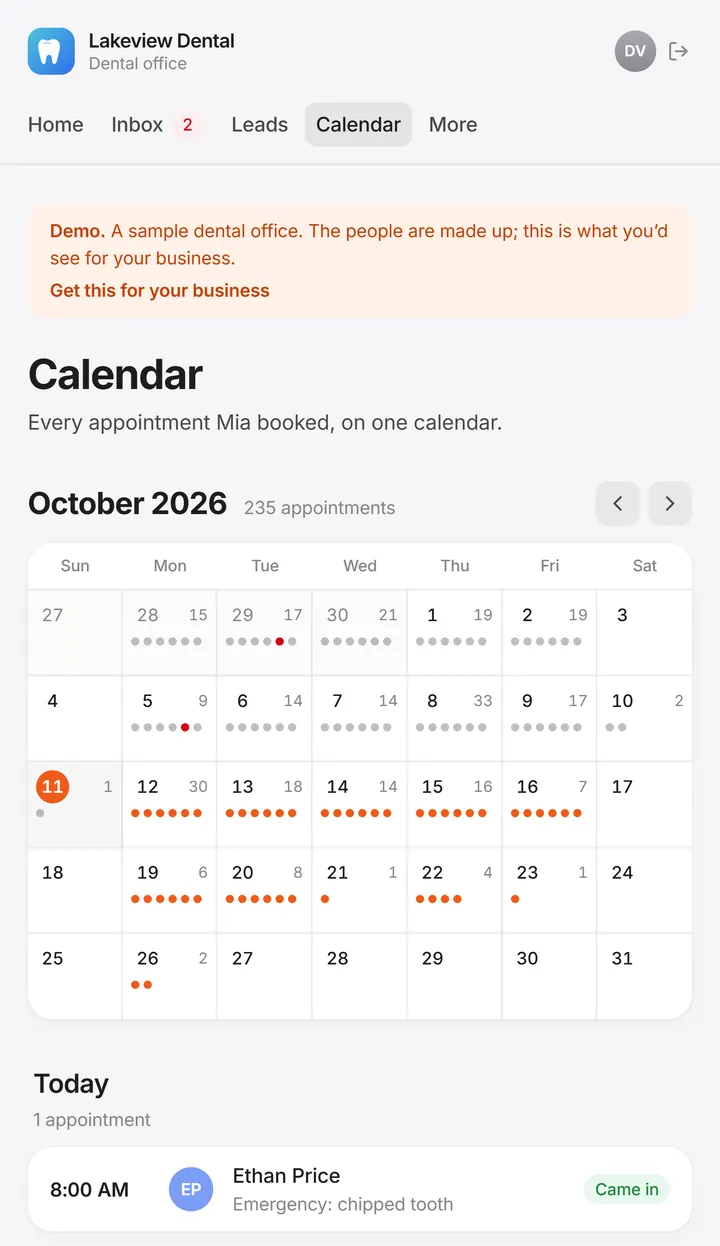
Mia, Margin's AI receptionist, answers every call or only the ones your team misses, books consultations onto the portal calendar and tells the office. She says she is an AI when asked, and hands off when someone asks for a person. You can keep an answering service you like and add her for the rest.
The limits: missed-call texts and follow-up wait for carriers to approve your number, and what she says about price or clinical matters is gone through on your audit before anything is built.
What Margin sets up for this.
- Mia, the AI receptionist, on every call
- Booking onto your calendar
- Follow-up until they book or say no
- Missed calls texted back within a minute
What a business needs is decided on its audit. It is a one-time setup fee and a monthly fee, with exact numbers on the audit.
How Margin works for cosmetic and elective medical practicesSee the portal with a sample businessThe Surgery Accelerator, for plastic surgeons
Related questions
Can an answering service book cosmetic surgery consultations?
Some can, if you give them access to a calendar and a script, and others only take messages. A cosmetic surgery practice should ask exactly what happens on a new-patient call before signing with any service.
Will an AI receptionist replace my cosmetic surgery front desk?
It does not need to. A cosmetic surgery practice can have the AI answer only the calls the team misses: lunch, after hours and busy lines. The front desk keeps the patients in the room and the calls it can reach.
Which is more private for cosmetic surgery callers?
Privacy depends on how each provider handles call information, not on whether a person or an AI answers. A cosmetic surgery practice should ask any provider who can see conversations and how they are stored, and get the answer in writing.