Will cosmetic surgery patients mind talking to an AI receptionist?
By the Margin Media team · Updated
Some cosmetic surgery patients will mind talking to an AI receptionist and some will not, and no honest figure says how many. What a practice can control is the set-up: the AI says what it is when asked, it answers quickly and well, and anyone who wants a person gets one. The real alternative, after hours, is a voicemail.
What do callers actually object to?
Callers object to being stuck, not to the technology itself. A menu with no exit, a voice that cannot understand them, or a system that pretends to be a person and is caught out: those are what people complain about. An answer that is quick, clear about what it is and able to help is a different experience.
What makes it acceptable in a cosmetic surgery practice?
Four things make it acceptable, and all of them are choices you make when it is set up. Ask any provider to show you each one working before you agree to anything.
- Honesty: asked whether it is an AI, it says yes.
- A way out: a caller who asks for a person is passed to your team.
- Limits: it does not give medical advice or guess at clinical answers.
- Scope: it can take only the calls your team misses, if you prefer.
When should a person take the call?
A person should take the call when the caller is upset, when a patient has a concern after a procedure, or when the question is clinical. Those calls need judgement and care. Decide in advance which calls go straight to staff, and make sure the hand-off reaches someone who will act on it that day.
How does Margin set Mia up for a cosmetic surgery practice?
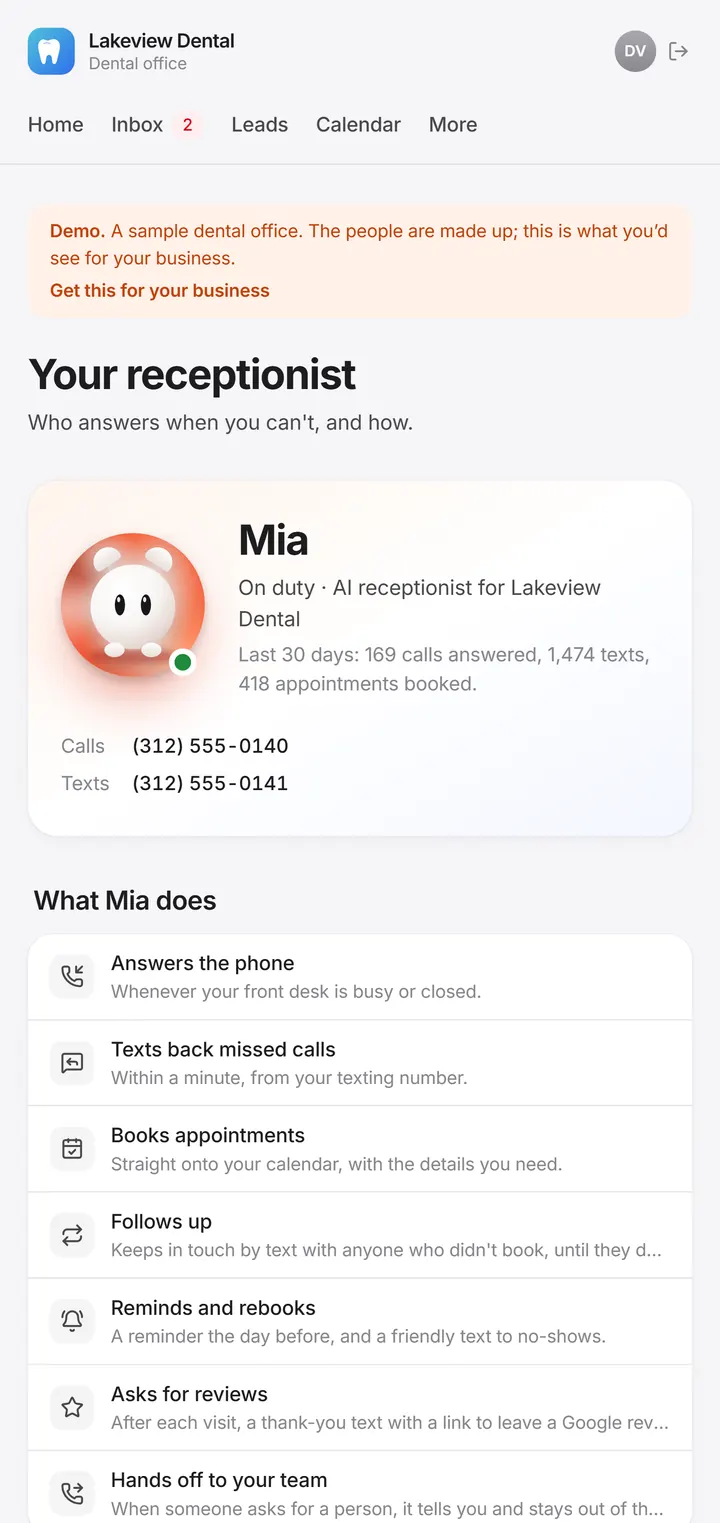
Mia never pretends to be a person. If someone asks, she says she is your AI assistant. You decide whether she says so in her greeting, and whether she answers every call or only the ones your team misses. When a caller asks for a person, she tells the office and steps aside.
Anything urgent is passed straight to your team. The easiest way to judge how patients will react is to call her yourself on (689) 345-9108. She is new, so we will not tell you what she has done for anyone else.
What Margin sets up for this.
- Mia, the AI receptionist, on every call
- Your portal: every call, text and booking
What a business needs is decided on its audit. It is a one-time setup fee and a monthly fee, with exact numbers on the audit.
How Margin works for cosmetic and elective medical practicesSee the portal with a sample businessThe Surgery Accelerator, for plastic surgeons
Related questions
Should a cosmetic surgery practice tell callers they are speaking to an AI?
It should never deny it. Whether the greeting says so up front is a choice for the cosmetic surgery practice, but an AI that claims to be human and is found out does more damage than one that is plain about it.
Are cosmetic surgery patients more private than other callers?
The subject is personal, so a cosmetic surgery practice should assume its callers care about discretion. Some patients find it easier to ask a first question of an AI than of a person, and others want a human voice. Offer both.
What happens if an AI receptionist cannot answer a cosmetic surgery question?
It should say so and take the details, not guess. In a cosmetic surgery practice, clinical questions and anything outside the approved answers should go to the team as a call-back, with the conversation attached.